AI Scribe Cost 2026: Human vs Ambient AI
Human scribes cost $30,000 to $50,000 a year once you count training and management. AI ambient scribes cost $150 to $400 a month. The price comparison is easy. The workflow comparison is the one that decides it.
The Documentation Problem That Both Solutions Address
Physicians in outpatient practice spend an average of 1.5 to 2 hours per workday on clinical documentation. That covers notes, orders, referral letters and after-visit summaries. For a physician seeing 20 patients per day, that is 4 to 6 minutes of documentation per encounter outside the room. Multiply by 220 working days and you have 330 to 440 hours of documentation time annually that has nothing to do with direct patient care.
Both human scribes and AI ambient scribes target this problem. They differ fundamentally in how they work, what they cost, and what workflow changes they require. This analysis is designed to give you the numbers you need to make an informed choice.
The True Cost of a Human Scribe
Human medical scribes are in-person (or virtual) staff who accompany the physician during patient encounters and draft documentation in real time. Here is the complete cost picture:
| Cost Component | Annual Amount | Notes |
|---|---|---|
| Scribe salary (in-person) | $32,000 to $42,000 | Entry-level, national average; varies by market |
| Payroll taxes (employer share) | $3,200 to $4,200 | ~10% of salary (FICA, FUTA, SUTA) |
| Benefits (health insurance partial) | $2,400 to $6,000 | Varies; many scribes are PRN without full benefits |
| Training and onboarding | $1,500 to $3,000 | First-year cost; includes clinical vocabulary training |
| Management overhead | $2,000 to $4,000 | Scheduling, HR management, performance review |
| Turnover cost (30 to 40% annual) | $4,000 to $8,000 | Recruiting, re-training new scribe annually |
| Total annual cost | $45,100 to $67,200 |
For a virtual scribe service (offshore or domestic remote scribing), costs are typically $20 to $35/hour, which at full-time usage (1,760 hours/year) runs $35,200 to $61,600 annually, similar range, no HR overhead, but with audio quality and connectivity dependencies.
The True Cost of an AI Ambient Scribe
| Cost Component | Annual Amount | Notes |
|---|---|---|
| AI scribe subscription (standalone) | $1,800 to $4,800 | $150 to $400/mo; varies by vendor and features |
| AI scribe included in EMR (e.g., Krasyn) | $0 incremental | Built-in to platform subscription |
| Setup and workflow training | $0 to $500 | Most vendors provide self-service onboarding; minimal IT work |
| Provider adaptation time | First 2 to 4 weeks | Not a cash cost; physician learns to speak naturally during visits |
| Ongoing management | ~$0 | No HR, no scheduling, no turnover |
| Total annual cost | $1,800 to $4,800 |
3-Year Cost Comparison
| Year | Human Scribe (mid-range) | AI Scribe (standalone, mid-range) | Difference |
|---|---|---|---|
| Year 1 | $56,000 | $3,300 | $52,700 |
| Year 2 | $54,000 | $3,300 | $50,700 |
| Year 3 | $54,000 | $3,300 | $50,700 |
| 3-Year Total | $164,000 | $9,900 | $154,100 |
The math favors AI scribing decisively on cost. The question is whether the quality and workflow trade-offs make it a genuine substitute.
Documentation Quality: What the Research Shows
A 2023 JAMA Network Open study of ambient AI scribing at a multi-site outpatient practice found that AI-drafted notes required physician edit time averaging 1.8 minutes, compared to 4.2 minutes for traditional physician documentation without a scribe. Note quality (assessed by peer review for completeness, accuracy, and medical necessity support) was rated equivalent or better for AI-assisted notes in 84% of encounters.
A 2024 Mayo Clinic study reported that AI scribe adoption reduced after-hours documentation (pajama time) by 36% and physician burnout scores improved by 23% on standardized scales over a 6-month follow-up period.
Human scribes can outperform AI on complex encounters with significant background noise, heavy patient interaction, or highly specialized clinical vocabulary not represented in the AI's training data. They can also catch non-verbal clinical cues and ask real-time clarifying questions. These advantages diminish as AI models improve, but they are real today for a subset of encounters.
Workflow Comparison
| Workflow Dimension | Human Scribe | AI Ambient Scribe |
|---|---|---|
| Documentation during encounter | Real-time; scribe types as visit progresses | Real-time audio capture; draft available within 30 to 90 sec of encounter end |
| BAA & data handling | BAA required; scribe is a workforce member | BAA with vendor; audio processed via infrastructure built to support HIPAA requirements |
| Patient comfort | Some patients uncomfortable with 3rd person in room | Small microphone on table; most patients neutral to positive |
| Complex terminology | Excels; can ask physician for clarification | Strong; occasional errors on highly specialized or rare terms |
| Note structure | Follows physician's preferred template if trained | Configurable templates; adapts to physician style over time |
| After-hours availability | Limited by staffing; overtime costs | Available 24/7; no incremental cost for additional encounters |
| Scaling across providers | Linear cost increase per provider | Flat or marginal cost increase; scales across entire practice |
| Turnover risk | High (30 to 40% annual turnover among scribes) | None |
What the Cost Tables Miss
Every comparison you'll read, including the tables above, prices the tool. None of them price the part that decides whether you keep using it: how long you spend editing the draft.
That's the number to measure, because it's the one that moves. A draft you accept with a glance and a draft you rewrite for four minutes cost the same in subscription dollars and nothing like the same in your evening.
Work it as arithmetic with your own numbers. Twenty encounters a day, 220 days, and three minutes of editing per note is about 220 hours a year. Cut the edit to ninety seconds and you've halved it. That single variable swamps the difference between a $150 subscription and a $400 one, which is why comparing vendors on price alone tends to pick the wrong one.
So when you trial a scribe, don't time the recording. Time the gap between the visit ending and the note being signed, and do it for at least a week, because the first two days are always the worst.
Where Ambient Scribes Actually Struggle
A fair comparison has to say what the technology is bad at, and vendors rarely will.
- Rooms with more than two voices. A parent, a child and you is a harder problem than a single adult. Family members who answer on the patient's behalf produce drafts that attribute history to the wrong person, which you have to catch.
- Accents and code-switching. Recognition quality is not uniform across speakers, and it degrades on the exact patients whose histories are hardest to take. This is worth testing deliberately with your own panel rather than assuming vendor demo audio represents it.
- The unspoken exam. If you don't narrate what you're doing, it isn't in the audio, so it isn't in the draft. Ambient documentation quietly pushes you toward saying findings out loud, which some physicians like and some find performative.
- Telehealth audio. A compressed video call is not the same input as a room microphone. Test your telehealth path separately, because a scribe that's excellent in the room can be mediocre over a bad connection.
- Interruptions. Real visits get interrupted. The draft usually keeps whatever was said during the interruption, which means the tool is only as good as your review habit.
None of that argues against ambient documentation. It argues for trialling it on your real patients rather than on a vendor's sample.
The Draft Is Not the Note
The distinction that matters clinically, and the one that should decide which product you pick, is what stands between a generated draft and a signed note.
A draft is a starting point. The note is a legal record you're attesting to. Any product that blurs those two is selling you a liability, and the place to look is the sign-off path, not the marketing page.
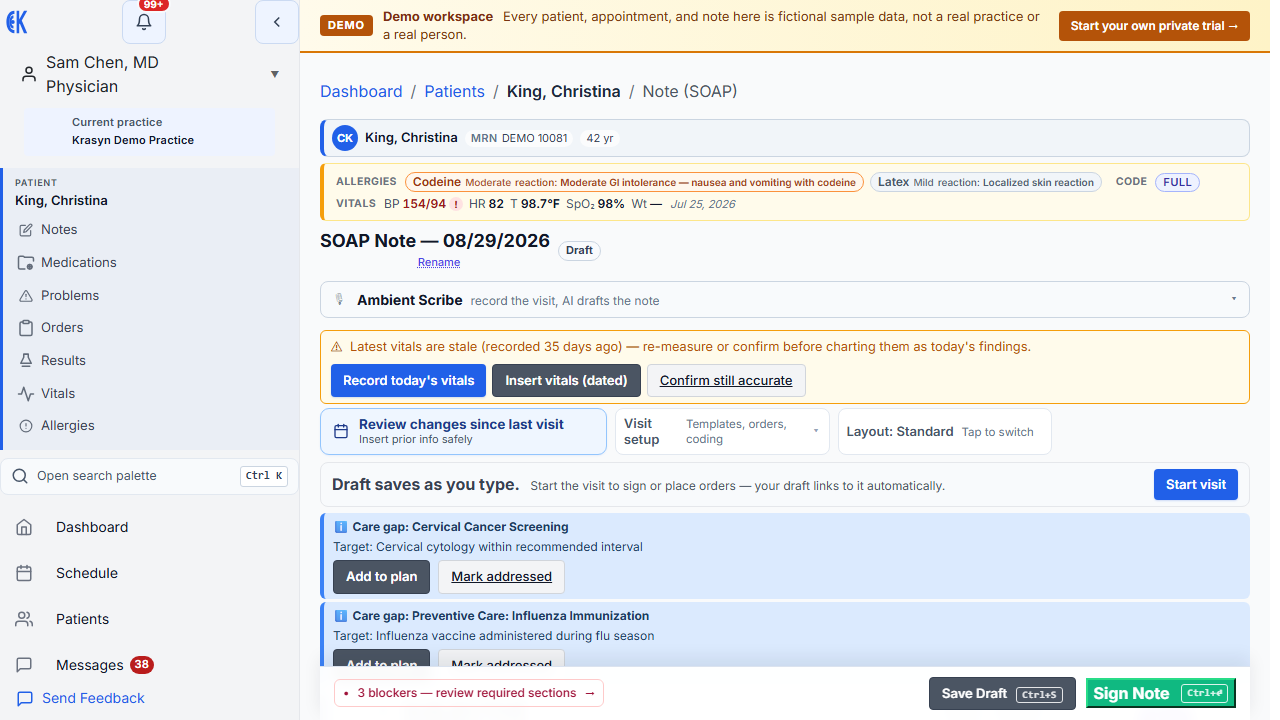
Two things in that screen are worth copying whatever product you choose. The first is that required sections announce themselves as incomplete rather than letting an empty heading pass as a finished note. The second is that the blockers indicator sits beside the sign button, so the thing preventing sign-off is visible at the moment you try to sign rather than after.
The allergy banner and the flagged vital across the top are the same idea applied to safety. A generated draft can be fluent and still miss that the blood pressure in front of you is abnormal, so the chart surfaces it independently of whatever the draft says.
Consent, Business Associate Agreements, and What the Recording Actually Is
Ambient documentation records patient conversations, which makes it a compliance decision as much as a workflow one. Three questions to settle before you sign anything.
Is the audio retained, and for how long? Some products keep audio to improve their models, some discard it after drafting. These are very different privacy postures and both are defensible, but you can't answer a patient's question about it if you don't know which one you bought.
Is there a signed business associate agreement? Any vendor processing identifiable patient information on your behalf needs one. Ask for it before the trial, not after, because a trial on real patients is already the thing the agreement covers.
What are you telling patients? State law on recording varies, and beyond the legal minimum there's a practical point: patients notice a phone or microphone on the desk. A short, plain sentence at the start of the visit tends to land better than saying nothing and hoping nobody asks.
How to Evaluate One in Two Weeks
A short structured trial tells you more than a long unstructured one.
- Week one, baseline. Don't change anything. Record the time between each visit ending and its note being signed. You need this number or you'll have nothing to compare against, and almost nobody collects it.
- Week two, scribe on. Same measurement, same patient mix. Deliberately include the hard cases: the multi-speaker rooms, the accents, the telehealth visits.
- Count the edits, not the wins. Note how many drafts you accepted nearly as written against how many you substantially rewrote. The ratio matters more than the average.
- Check one note a day against what actually happened. Not for typos. For anything asserted that you didn't say, which is the failure mode that matters and the one speed metrics never catch.
If the second week isn't clearly better than the first, the product isn't right for your practice, and no subscription price makes it right.
When a Human Scribe Still Makes Sense
There are specific practice situations where a human scribe remains the better choice despite higher cost:
- High procedure volume: Practices that do frequent in-office procedures (joint injections, biopsies, colposcopies) may find the scribe valuable for real-time procedure documentation and specimen handling, tasks that AI cannot assist with
- Highly subspecialized vocabulary: Subspecialty practices with rare disease focus (e.g., academic rheumatology, hereditary cancer genetics) may find AI accuracy insufficient for their specific terminology
- Provider preference: Some physicians simply prefer real-time human collaboration in the room and are willing to pay the premium for it
- Regulatory environments with audio recording restrictions: A small number of state laws or institutional policies complicate audio capture; verify before adopting AI scribing
The Hybrid Approach
Some practices are adopting a hybrid model: AI scribing for straightforward primary care encounters (follow-ups, annual wellness visits, simple acute care) and human scribing or traditional documentation for complex subspecialty cases, procedures, or difficult encounters. This can reduce human scribe hours from full-time to part-time (8 to 12 hours/week), lowering the human scribe cost to $8,000 to $15,000 annually while keeping AI scribing for 70 to 80% of encounters.
Which One Should You Actually Pick
For most solo and small outpatient practices the arithmetic isn't close, and the tables above make that obvious. The interesting decision isn't human against AI. It's whether the scribe you choose is a separate product you paste notes out of, or part of the record you already work in.
A standalone scribe drafts from the conversation and nothing else. It doesn't know the patient's problem list, it can't see that a vital is abnormal, and it has no way to flag that a care gap is open. Everything it produces has to cross a boundary into your chart, and every boundary crossing is somewhere a note can be pasted into the wrong record.
A scribe built into the record can do the thing the screenshot above shows: draft the note, and at the same time hold the sign-off gate, surface the allergy banner, and put the open care gaps in front of you while you're still writing the plan. That's not a documentation feature. It's the difference between a tool that writes faster and a tool that helps you not miss things.
This matters more in membership practice than in fee-for-service, because in direct primary care the longer visit is the product. A scribe that lets you keep your attention on the patient is protecting the thing your members are paying for, not just saving you time after hours.
The honest way to settle it is to run your own audio through one. Try a Krasyn sample note first to see how the draft traces each sentence to the transcript, then record real visits during a trial before you commit to any vendor, including this one, and measure the edit time rather than the demo.
Getting Started with AI Scribing
The typical on-ramp for AI ambient scribing is 2 to 4 weeks of adaptation, during which physicians learn to speak naturally for the documentation (including saying things like "patient reports" or "on exam" to help the AI structure the note correctly) and refine their review-and-sign workflow. Most physicians report that after the adaptation period, documentation time drops to 1 to 2 minutes per note.
Krasyn's AI scribe is built into the platform, not a third-party add-on, which means the AI has full context of the patient chart (problem list, medications, recent labs) when drafting the note. Watch a live demo of the AI scribe workflow to see what the adaptation period looks like and what the final note output looks like for a typical primary care encounter.