DPC Billing Guide 2026: Memberships, Hybrid, and Tax
Direct Primary Care membership billing is structurally different from fee-for-service. This guide covers membership fee structures, hybrid billing, tax treatment, and the EMR features that make DPC economics work.
How DPC Billing Is Fundamentally Different from Fee-for-Service
In a traditional fee-for-service practice, you document an encounter, assign CPT and ICD-10 codes, submit a claim to a payer, and wait 30 to 90 days for reimbursement. In Direct Primary Care, you collect a flat monthly membership fee directly from patients. No claims. No prior authorizations. For most primary care services covered by the membership, no coding at all.
That simplicity is the core economic proposition. But the billing layer isn't zero, it's different. You still need a way to collect recurring fees, manage tiers, track panel capacity, handle cancellations, and, if you run hybrid, submit fee-for-service claims for the things the membership doesn't cover.
The mistake most physicians make in year one is assuming that dropping claims means dropping billing operations. What actually happens is that the work moves. Instead of chasing denials, you're chasing expired cards.
Where the Billing Work Goes
It helps to see the two models side by side, because the failure modes are not the same and neither are the skills you need to hire for.
| Operation | Fee-for-service | Membership DPC |
|---|---|---|
| Revenue trigger | Documented and coded encounter | Active membership on the billing date |
| Typical lag to cash | 30 to 90 days after the claim | Same day the charge clears |
| Main failure mode | Denial, downcode, prior auth | Declined card, expired card, chargeback |
| Who chases it | Biller or RCM vendor | Front desk, or nobody, which is the problem |
| Revenue per patient | Varies by visit and code | Fixed and known 12 months out |
| What grows revenue | More visits or higher levels | More members, or less churn |
| Coding burden | Every encounter | Only the out-of-membership work |
Read the last two rows together, because they explain why DPC feels different to practice. In fee-for-service, seeing one more patient today makes money today. In DPC it doesn't. Revenue this month was decided by who joined last month and who stayed. That's what makes the longer visit affordable, and it's also why a quiet attrition problem can go unnoticed for a quarter.
Membership Fee Structures That Work in 2026
Membership fees vary by geography, patient age, and panel strategy. These are the structures you'll see most often:
| Patient Category | Monthly Fee Range | Notes |
|---|---|---|
| Adult (18 to 64) | $75 to $125/mo | Core membership, most common tier |
| Senior (65+) | $100 to $150/mo | Higher utilization, often priced above the adult tier |
| Child (0 to 17) | $30 to $60/mo | Often discounted when an adult is the primary member |
| Family cap | $250 to $400/mo | Capped rate for two or more adults plus children |
| Employer group | $55 to $90/mo/employee | Negotiated bulk rates, usually below the retail adult tier |
Setting Your Membership Fee
The right fee depends on your target panel size, your overhead, and the income you want. The arithmetic is simple:
Annual membership revenue = panel size x monthly fee x 12
Work an example. Six hundred patients at $85 a month is $612,000 gross. Subtract overhead of $180,000 to $220,000 for staff, rent, malpractice and supplies, and you're looking at $390,000 to $430,000 before any fee-for-service revenue from work outside the membership.
Those overhead figures are a planning range, not a benchmark. Your rent and your staffing model will move them more than anything else on this page, so build the model with your own numbers before you set a price.
The Number Most Practices Model Wrong
New DPC practices model gross revenue and forget involuntary churn. Not patients who quit, patients whose payment quietly fails.
Run it as arithmetic. Take the same 600 members at $85. If two percent of charges fail in a given month and half of those are never recovered, that's six members of revenue gone, about $510 that month. Annualized, and assuming the unrecovered ones stay gone, you're carrying a hole worth several thousand dollars that never appears as a cancellation. Nobody called to quit. The card just expired.
This is the single most useful thing to instrument in year one, and it's cheap to fix compared to recruiting replacement members. A failed charge that gets a same-week retry and a text message usually recovers. A failed charge nobody looks at until quarter end usually doesn't.
The Four Things That Break DPC Collections
- Card expiry. Cards expire on a schedule you don't control, and a membership that bills on the first will fail silently on the first. Card updater services from the major networks handle much of this automatically, and they're worth asking your processor about by name.
- Mid-cycle joins. A patient who joins on the 20th either gets a prorated first charge or a full one. Pick a policy, write it into the agreement, and make sure the system does the same thing every time. Inconsistent proration generates refund requests, and refund requests cost more staff time than the money involved.
- Family composition changes. A child ages out, a spouse leaves, a family cap no longer applies. These are the changes most likely to be handled by hand, and handled by hand means eventually missed.
- Medicare age-ins. A member turning 65 is a compliance event, not just a billing one. See the Medicare section below, and put the date in a system that will actually remind you.
What Services Must You Include in the Membership?
State law governs what a DPC membership can and cannot cover. In nearly all states, memberships may include:
- Unlimited primary care office visits, in person and by telehealth
- Basic in-office procedures such as skin biopsies, joint injections and laceration repair
- Chronic disease management and medication management
- Care coordination and referral management
- Direct messaging and phone access
What memberships generally may not include: hospital care, specialist care, imaging beyond point of care, surgical procedures, and anything that would make the arrangement look like an insurance product to your state regulator.
Hybrid DPC: Billing Insurance for Outside-Membership Services
Many practices run hybrid, collecting membership fees for primary care while billing insurance for services outside the membership scope. This works, and it's how a lot of practices survive the transition year, but it doubles your billing surface. You now need clean separation between what the membership covers and what gets a claim, and you need that separation to be obvious in the chart at the moment of the visit rather than reconstructed later by a biller.
Medicare and DPC: The Critical Compliance Issue
You cannot bill Medicare for services already covered by a DPC membership fee. That's the line, and it's the one regulators care about most. Practices generally choose one of three paths: opt out of Medicare entirely and see Medicare patients under private contract, keep Medicare participation and exclude Medicare patients from the membership, or keep participation and carefully scope the membership so it covers only services Medicare doesn't. The third path is the one that needs a healthcare attorney, not a blog post.
DPC and HSA/FSA: Tax Treatment in 2026
The tax treatment of DPC fees has been contested for years, and the position has moved. Confirm the current rule with your accountant before you put anything in writing to patients, and be careful about how the membership agreement describes the fee. Patients will ask, and the wrong confident answer is worse than saying you'll check.
Employer DPC Arrangements
Employer contracts change the shape of the practice. One signature can add thirty members at once, which is excellent for revenue and hard on onboarding. Negotiate the per-employee rate below your retail tier, but protect yourself on two things: a minimum term, and a cap on how fast enrollment lands. Thirty new patients in a week will damage the experience the existing panel is paying for.
Panel Size Is the Unit of Economics
Everything above resolves to one number. In fee-for-service the daily schedule is the unit that matters. In DPC it's the panel, and the two are not the same thing. Your schedule today might be five patients while your panel is several hundred, and the panel is what pays you.
That distinction should be visible in the software you use every day. In Krasyn the provider dashboard shows the schedule and the panel next to each other, so the number that drives revenue isn't buried in a report you run at month end.
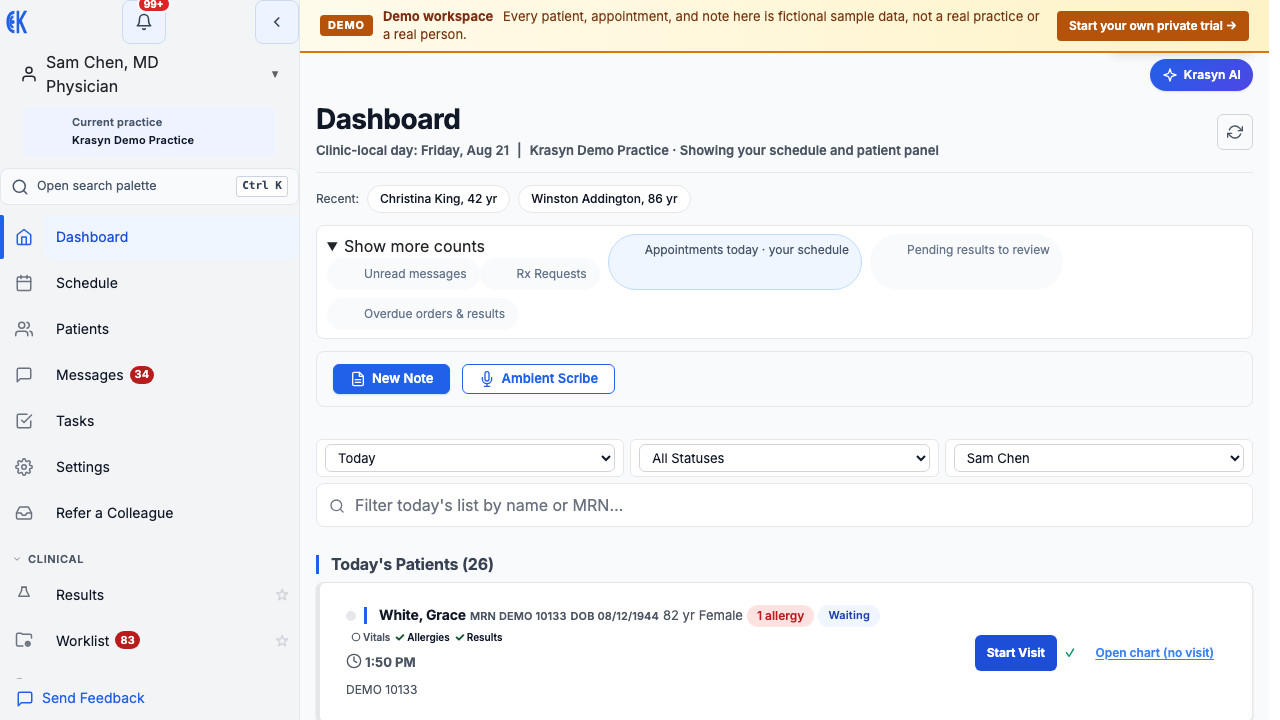
The counts matter as much as the panel number. A DPC membership usually promises direct messaging access, which makes the unread message count a service level commitment you've sold rather than just an inbox. If it climbs while the panel grows, you've found your capacity ceiling before your patients find it for you.
The same screen carries a preventive care gaps section and a recall list status. Those aren't DPC-specific, but they matter more in DPC than they do in fee-for-service, because nobody is paying you per visit to catch them. Prevention work in a membership model is something you absorb, so it needs to be surfaced rather than hunted for.
The EMR Features That Make DPC Economics Work
- Recurring membership billing: automatic monthly or annual charges, card updates, failed payment retries, and dunning that runs without someone remembering to run it
- Membership tier management: different rates by age band and family structure, with changes that apply cleanly at the next billing date
- Panel capacity tracking: current panel against target, with a waitlist you can actually work
- Hybrid claim routing: a clear split between membership-covered work and billable work, decided at the point of care
- Utilization visibility: encounters per member per month, so you can see which members are consuming the capacity you sold to everyone else
- Ambient documentation: DPC visits tend to be longer and the notes tend to be richer, which is exactly where drafting from the conversation saves the most time
Krasyn's DPC support includes membership billing, panel management and ambient documentation built for this workflow rather than adapted from a fee-for-service system. See the DPC feature set, review pricing, or try a sample note: the scribe drafts a SOAP note from a synthetic transcript, links each sentence to the line it came from, and shows the Note Check report, with no account needed.
Setting Up Your DPC Practice for Financial Success
Start with the Right Panel Target
Most DPC physicians cap the panel somewhere in the high hundreds. Pick your number before you open, because the pressure to say yes to one more family is constant and it compounds quietly. If the panel drifts toward a thousand, you've rebuilt the volume treadmill you left.
Negotiate Wholesale Lab Pricing
Direct pricing through a national or regional reference lab lets you pass near-cost labs to patients. The spread between the retail price a patient sees through insurance and the wholesale price you can arrange is large enough that patients notice immediately. Get your own quote rather than trusting a published figure, then say the number out loud in every new member conversation.
Build an Attrition Reserve
Members move, change employers, and age into Medicare. Some of that is predictable and some isn't, so keep a waitlist and an onboarding process that can absorb a steady trickle of new patients without disrupting the panel you already have. A practice that can onboard smoothly every month is more stable than one that recruits in panicked bursts after a bad quarter.
The Transition Year Is a Cash Flow Problem, Not a Clinical One
Physicians leaving fee-for-service usually plan the clinical side carefully and underplan the twelve months where both models overlap. It's worth walking through, because the shape of it surprises people.
Your fee-for-service accounts receivable winds down on the payers' schedule, not yours. Claims submitted in your last active month are still landing 30 to 90 days later, which is helpful, and then that tail stops. Meanwhile membership revenue starts near zero and climbs with enrollment. The two curves cross somewhere, and the gap between them is the money you need in the bank before you start.
Model it month by month rather than annually, because an annual model hides the trough entirely. Put your projected new members in one column and your declining fee-for-service collections in another. The month with the largest negative difference is your actual capital requirement, and for most solo transitions it lands well before month six.
Two things make that trough shallower. The first is signing an employer group before you open, since one contract moves the enrollment curve up by a step rather than a slope. The second is running hybrid deliberately for a defined period instead of drifting into it. Hybrid billing costs you operational complexity, so it should be a decision with an end date, not a permanent hedge you never revisit.
What to Ask a Payment Processor Before You Sign
Membership billing lives or dies on the processor, and the questions that matter aren't the ones on the pricing page.
- Do you support automatic card updater? This is the single feature that most reduces involuntary churn, and not every processor includes it by default
- What's the retry schedule on a failed charge, and can I change it? A fixed retry the next morning recovers far less than a retry timed to a typical payday
- How are refunds and prorations handled? You'll do more of these than you expect in the first six months
- What happens to stored cards if I leave? If the answer is that they stay with the processor, you have a switching cost you haven't priced
- Is there a healthcare-specific agreement? Some processors treat medical practices differently for chargeback and reserve purposes, and you want that in writing before volume arrives
Ask the last one early. A reserve hold discovered in month three is a cash flow event on top of the one you already planned for.
Key Compliance Checkpoints
- Check whether your state requires registration with the insurance department, since several states have DPC-enabling legislation with a filing requirement
- Make sure the membership agreement defines included and excluded services in plain language a patient will actually read
- Never market the membership as insurance. It isn't, and regulators have acted against practices that blurred the line
- If you've opted out of Medicare, track your opt-out paperwork and renewal dates somewhere that will remind you
- Review the membership agreement with a healthcare attorney annually, and immediately if your state's DPC statute changes
None of this is exotic. It's a different set of operational habits from the ones fee-for-service taught you, and the practices that do well are usually the ones that treated the switch as an operations project rather than only a clinical one.